Logo University of Applied Sciences and Arts Northwestern Switzerland, School of Computer Science

Astroinformatics, Space Sciences and Heliophysics at the FHNW School of Computer Science

STIX

Spectrometer Telescope for Imaging X-rays


STIX is on its way to the Sun on board
the European Space Agency’s spacecraft Solar Orbiter.

ROLE OF THE INSTITUTE FOR DATA SCIENCE


> Project lead

> Instrument design and construction

> Flight software, ground software

> Science

Principal investigator: Säm Krucker

Partners: international consortium, academy&industry
CH-partners: Kögl Space GmbH, Art of Technology, Almatech, Paul Scherrer Institut

Funding: ESA/Prodex, Swiss Space Office, SNSF

Start of project: 2010
Instrument delivered: 2017
Spacecraft launched: February 9/10, 2020
Instrument turned on: April 14, 2020
Science: ongoing


Keywords: space sciences, solar physics, Solar Orbiter


ZUSAMMENFASSUNG IN DEUTSCH

Solar Orbiter untersucht die Sonne aus der Nähe
Die Europäische Raumfahrtbehörde ESA baute die Raumsonde Solar Orbiter, welche unseren nächsten Stern in einer Distanz von 50 Millionen km umrunden wird. Das ist ein Drittel des Abstandes zwischen Sonne und Erde. Die Sonde wird der Sonne näher kommen als der nächste Planet Merkur. An Bord befinden sich 10 spezielle Instrumente, welche Bilder der Sonne machen und gleichzeitig die Umgebung vor Ort untersuchen.

Röntgenteleskop der FHNW
Eines der Instrumente wurde an der Fachhochschule Nordwestschweiz entwickelt und gebaut. Das Röntgenteleskop STIX ist ein Spektrometer mit 30 Detektoren mit vorgesetzten Gittern, durch welche die Röntgenstrahlen gelenkt werden. Die Bilder werden indirekt aus den Messungen rekonstruiert.

Start 10. Februar 2020
Solar Orbiter wurde mit einer Atlas V-Rakete von Cape Canaveral in den Weltraum befördert. Von dort aus begann die dreieinhalbjährige Reise zu unserem nächsten Stern. Unterwegs fliegt die Sonde mehrmals nahe des Planeten Venus und der Erde vorbei, um Schwung zu holen und auf die richtige Umlaufbahn gelenkt zu werden.

Beobachtungen in allen Wellenlängen
Bereits jetzt untersuchen mehrere Bodenteleskope und Raumsonden mit stets präziseren Instrumenten die Sonne in allen Wellenlängen des elektromagnetischen Spektrums, vom Radiobereich zu den hochenergetischen Röntgen- und Gammastrahlen, sowie die magnetischen Felder. Eine davon ist die NASA Parker Solar Probe, die im August 2018 startete und der Sonne so nahe kommen wird wie keine Sonde zuvor. Wegen der Nähe muss sie ihre Instrumente hinter einem Hitzeschild verbergen und kann nur Messungen vor Ort vornehmen. Solar Orbiter kommt der Sonne nicht ganz so nahe. Sie kann unseren Stern durch kleine Löcher im Hitzeschild direkt beobachten und gleichzeitig Messungen vor Ort machen.

Was will man untersuchen?
Die vielfältigen Beobachtungen sind notwendig, um die komplexe Dynamik zu untersuchen, die mit der Sonnenaktivität verbunden ist. Zum Beispiel, warum die Atmosphäre der Sonne heisser wird, je weiter sie von der Sonnenoberfläche entfernt ist, statt sich abzukühlen. Oder wie ein Sonnensturm entsteht und sich verbreitet. Das betrifft auch uns, denn grosse Explosionen auf der Sonne können Auswirkungen bis auf die Erde haben.

SUMMARY

STIX is an X-ray telescope designed and built at FHNW. It is one of 10 instruments on board Solar Orbiter, the ESA spacecraft travelling very close to the sun. The mission collects information in multiple wavelengths for studying solar activity in unprecedented detail. This will bring us a big step closer to understanding the workings of our closest star. STIX will contribute to this goal by providing imaging spectroscopy of solar X-ray emission and information on accelerated electrons associated with solar flares. It will look at the very point where solar eruptions start.

RESEARCH PROJECTS @FHNW WITH DATA FROM STIX AND RELATED INSTRUMENTS

Solar Orbiter STIX: Solar Max Science

This project focuses on one of Solar Orbiter’s main science questions: “How do solar eruptions produce energetic particle radiation that fills the heliosphere?” This question has been identified by the solar community as crucial to fundamental processes, including particle acceleration and magnetic reconnection. We will achieve this by addressing three specific science objectives via five well-coordinated work packages: 

• How are particles accelerated in the solar atmosphere? 
• How are accelerated particles transported in solar flares? 
• How do particles accelerated at the Sun fill the heliosphere? 

The output of these work packages will provide crucial new insights into the above science questions and have direct relevance to flare particle acceleration models and the space weather community. To take advantage of synergies built up over the past years, the work will be a collaboration between the Swiss STIX PI team at FHNW and the Austrian STIX Co-I team at UniGraz. Both institutions are world-leading experts in highenergy solar flare studies and hard X-ray observations. While the Swiss team contributes also the detailed technical expertise of STIX, runs the STIX instrument and STIX data center, the Austrian team brings in additional expertise on coronal field modelling and coronal mass ejections (CMEs) associated with flares. The results of the work are of key importance to the Solar Orbiter mission, and they are envisioned to trigger further collaborations between the proposing teams and the Solar Orbiter community.

Solar Orbiter Flare Campaign: Fragmented Energy Release

Solar Orbiter is ESA’s flagship mission in heliophysics to investigate how our Sun creates the heliosphere. Its instruments provide close-up views of the Sun taken from a viewpoint away from Earth, as well as out of the ecliptic. The new data obtained by Solar Orbiter is opening a new window in heliophysics, revolutionizing our field.

Making observations so close to the Sun has the main challenge that only a limited amount of data can be transmitted back to Earth. To observe at the right time to catch a solar flare is difficult, in particular as flare forecasting is still rather limited. As of 2024, Solar Orbiter has been running flare campaigns to try to catch a flare within windows of typically four hours each. Through careful planning and the right amount of luck, we have successfully observed 9 large flare (GOES M class) and many smaller flares with the extreme UV telescope HRI, the High-Resolution Imager of the EUI instrument suite. FHNW has been one of the initiators of the Solar Orbiter Flare Campaigns and provided the coordination lead for the flare campaigns of spring 2024 and 2025. While previous EUV imaging observations taken from Earth’s orbit suffered from inadequate resolution and saturation, through careful planning and by pushing the instrument to its limits, we have obtained a unique data set of EUV flare observations at high-spatial (150 km) and temporal resolution (2 s) without any saturated pixels. The HRI observations cover a large collection of flares from microflares up to large flares with very prominent signatures of particle acceleration allowing us to probe a wide range of energy release processes.

The most fascinating aspect of the newly obtained HRI flare observations is the high fragmentation of the flare ribbons in time and space. Fragmentation appears to be an intrinsic characteristic of the release process of magnetic energy. The newly available HRI flare observations therefore provide key diagnostics to unlock the mechanism of magnetic energy conversion in astrophysical plasmas. We propose to quantify the fragmentation through two well focused science objectives:

·       What are the time and size scales of flare ribbon heating?

·       What are the time scales of cooling of individual flare loops?

In a second step, we link the observations to simulations performed by the existing software package RADYN. The output of these work packages will provide fundamental new insights into the release of magnetic energy in astrophysical plasmas, and they are directly relevant for Space Weather.

PEOPLE @FHNW CURRENTLY WORKING ON STIX

Dr. Andrea Battaglia (I4DS)

Astrophysicist

Prof. Dr. Arnold Benz

Senior Advisor

Prof. Dr. André Csillaghy (I4DS)

Head Institute of Data Science

Laszlo Istvan Etesi (I4DS)

Co-I, Computer Science Engineer

Dr. Gordon Hurford (I4DS)

Instrument lead

Prof. Dr. Säm Krucker (I4DS)

Principal Investigator

Katja Lapadula (I4DS)

Finances/Controlling

Dr. Paolo Massa (I4DS)

Data Scientist

Hanna Sathiapal (I4DS)

Public Engagement Coordinator

Muriel Stiefel (I4DS)

Phd candidate

Dr. Hualin Xiao (PMOD)

Co-I, Physicist

PEOPLE  @FHNW WHO WORKED ON STIX BEFORE

  • Collier, Hannah, Dr. (I4DS) until 2025 
  • Palumbo, Barbara (UniGE), until 2025
  • Felix, Simon (I4DS) until 2024
  • Battaglia, Andrea, Dr. (I4DS) until 2024
  • Battaglia Marina, Dr. (I4DS) until 2024
  • Schramka, Filip (I4DS) until 2023
  • Ryan Dan, Dr. (I4DS) until 2023
  • Groebelbauer, Hans-Peter, Prof. Dr. (IPPE), until 2021
  • Kleint Lucia, Dr. (I4DS) until 2019
  • Casadei Diego, Dr. (I4DS) until 2018
  • Grimm Oliver, Dr. (I4DS) until 2020
  • Hochmuth Nicky (I4DS) until 2017
  • Iseli Linus (IPPE) until 2013
  • Kabosch Dino (IPPE) until 2013
  • Kobler Stefan (IPPE) until 2013
  • Kuhar Matej, Dr. (I4DS) until 2020
  • Molendini Francesca, Dr. (I4DS) until 2018
  • Repond Laurent (IPPE) until 2013
  • Schori Dominic (IPPE) until 2017

STUDENT PARTICIPATION

OPEN RESOURCES AND RESULTS

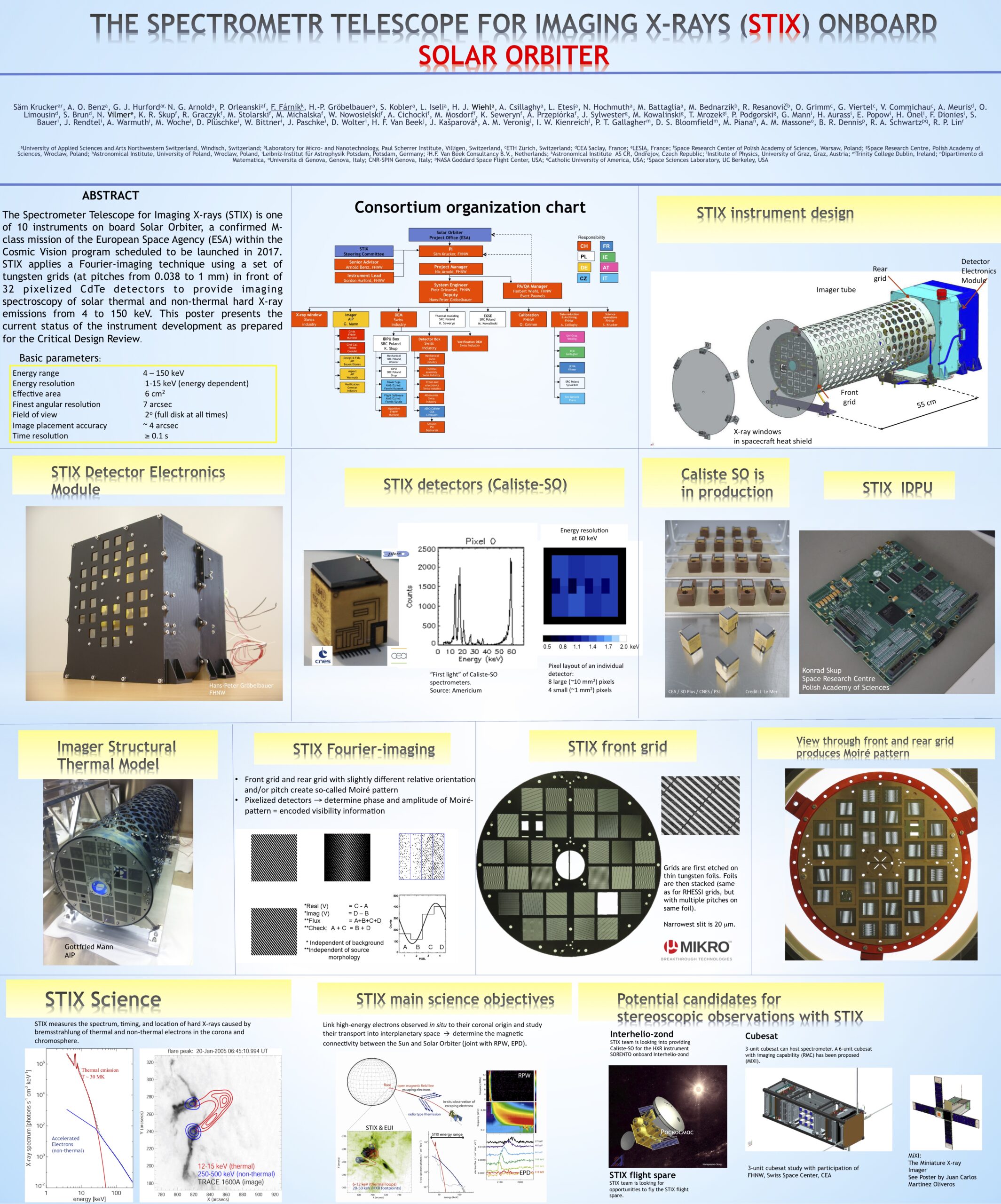
Poster STIX overview
The first flare observed by STIX
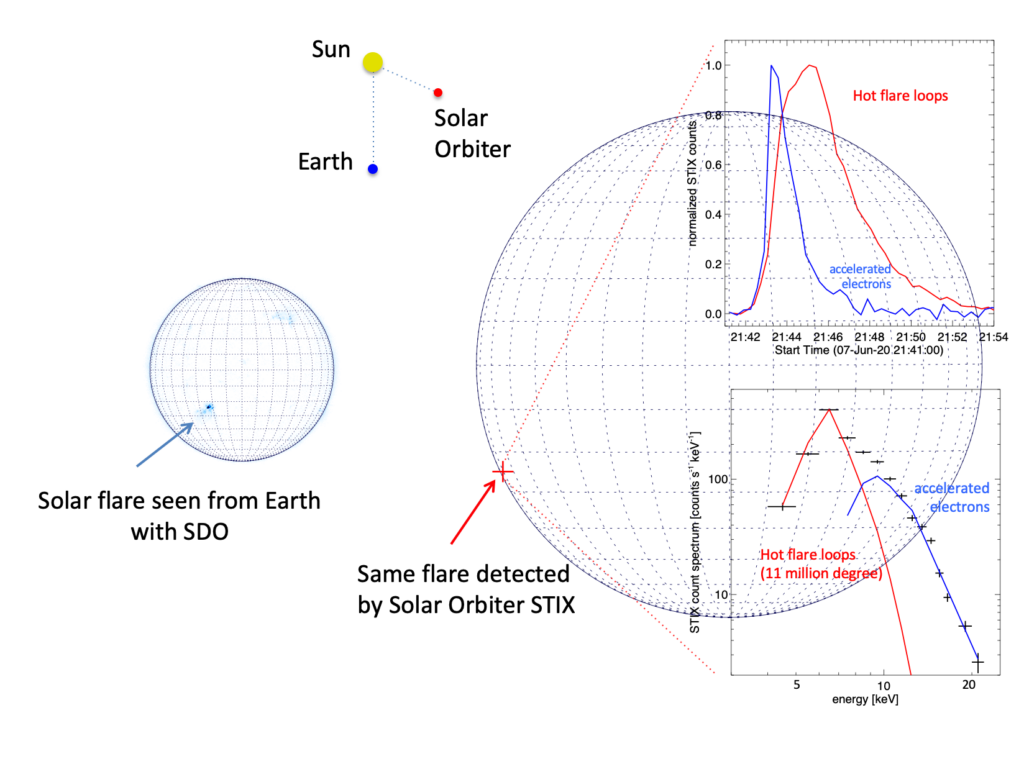
time profile and X-ray spectrum of the first flare observed by STIX

Time profile and X-ray spectrum of the flare of June 7th, 2020.

Am 7. Juni hatten wir Glück! Obwohl die Sonne in einer ruhigen Phase war, registrierte STIX noch während der Einschaltphase den ersten Sonnenflare. Dieser sendete Röntgenstrahlen aus, welche von allen 32 Detektoren registriert wurden. Nun wird daraus ein Bild konstruiert. Dies zum ersten Mal zu tun, ist mit einem enormen wissenschaftlichen und mathematischen Aufwand verbunden, da viele instrumentelle Korrekturen vorgenommen werden müssen. Wenn der Rekonstruktionsprozess erfolgreich ist, können Bilder automatisch generiert werden.

VISUALS AND AUDIO

Artist’s impression of Solar Orbiter. Credit: ESA
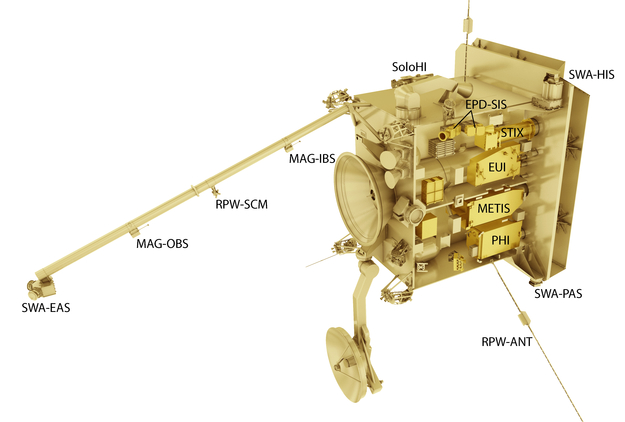
Payload accommodation onboard Solar Orbiter. STIX is one of ten scientific instruments. Credit: ESA
The X-ray telescope consists of 32 pairs of grids mounted in front of 32 X-ray detectors which are located on the electronics box and make up the spectrometer. X-ray radiation passes through the windows in the heat shield, it is subsequently filtered by the imager unit and finally detected by the detector box – in order to obtain images of the hottest regions of solar eruptions with temperatures of up to 40 million degrees Celsius. Credit:

SRF Tagesschau 8. Februar 2020

Die Schweiz spielt in der Weltraumforschung eine wichtige Roll. Bericht mit Auskünften von Samuel Krucker, Fachhochschule Nordwestschweiz, und Thomas Zurbuchen, Nasa. Angesprochen: Solar-Orbiter-Mission der ESA, Röntgen-Teleskop der FHNW

Am 14. April 2020 wurde das Röntgenteleskom im Weltraum während des Locldowns vom Homeoffice aus eingeschaltet. Der Software Ingenieur Laszlo Etesi hat den Prozess gefilmt.

Video First Contact

ESA schickt Raumsonde zur Sonne

by SRF Echo der Zeit, 7. Februar 2020 | Die anderthalb Milliarden Franken teure Raumsonde «Solar Orbiter» soll für die ESA während zehn Jahren die Sonne aus nächster Nähe betrachten. Mit an Bord ist auch Technik aus der Schweiz: "STIX" - ein Röntgenteleskop, entwickelt von Astrophysiker Säm Krucker und seinem Team an der FHNW.

Pressreview STIX Launch

21.02.2020

Zur Zeit der Starts im Februar 2020 wurde in der Schweizer Presse über hundert mal über STIX und Solar Orbiter berichtet.