Science and technology communication
Sharing space-related research at and beyond HSI
The Institute for Data Science has supported science communication for nearly two decades. Inspired by experiences in the US, the head of the institute wanted to bring public engagement to Switzerland. He found the doors wide open at the European Union who emphasized that all their research projects should engage in public outreach to help foster an informed society. We started from zero. Thanks to our European research projects, of which outreach was a mandatory component, we were able to establish a body of activities, educational materials and engagement formats to work with, step by step, project by project.
Science communication encompasses various, sometimes overlapping, fields, each with its own distinct perspective.
- Science Journalism
- Public Engagement & Outreach
- Formal and informal Science Education
- Citizen Science Coordination
- Museum & Exhibition Work
- Digital & Multimedia Production
- Policy & Government Communication
- Risk Communication
- Corporate Communication
All share one core mission: making specialized scientific knowledge accessible for diverse audiences in a meaningful way.
While science journalism, digital- and multimedia production and corporate communication is carried out by the University’s Markom teams, the Institute for Data Science focused on public engagement and informal science education around astronomy and space topics. However, we were also involved in most other fields: museum exhibitions, citizen science, digital communication (websites, social media), media relations, policy- and risk communication.
Space research at HSI is financed by public money, for example through the Swiss National Science Foundation SNSF, the European research programmes or the European Space Agency ESA, to whom the Swiss government contributes a considerable amount of money – all tax money. We believe that taxpayers should be informed about how their money is being spent and get something back from the knowledge created in a way that is meaningful to them.
Our goals were to
- increase the visibiliy of space activities at the FHNW, as many people still thought of a University of Applied Sciences as a school limited to train students,
- bridge the gap between science&technology and society by making s&t more accessible and giving taxpayers something back of what they payed for: the exciting fields of research in which we have the privilege of working,
- improve the practice of inclusion towards more equal opportunities for everyone who has limited access to space topics and the academic world in general.
We planned to reach these goals by systematically showing and shareing what we do at the cutting edge of s&t to different audiences in a suitable way, for example by creating opportunities for scientists and the public to meet on an eye-to-eye level. This involved a particular kind of exhibit design, the development of dedicated educational materials, experimenting with different approaches etc.
Many of our programs helped encourage the next generation to pursue STEAM subjects. Although this was not our main goal, and in the meantime is covered by a specific Office for the Promotion of Young Talent at HTU/HSI, this was a welcome side effect.
In the end, we hoped to contribute to a better-informed democratic society.
Over the past 20 years, we
- published over 1000 carefully designed social media posts,
- coordinated science communication for six international research projects,
- designed and ran 10 project websites,
- developed and delivered hundreds of children’s workshops,
- contributed to dozens of public events – on the FHNW campus, in Switzerland and abroad,
- organized three mission launch parties (STIX 2021, Euclid 2023, SMILE 2026).
Fun fact: our most successful blog post was ‘How hot is the Sun?’ (2012). 🌞
One more fun fact: ±1000 people visited the eclipse event we organized on the campus for the kindergarten class of a co-worker’s son (2015). 😎
Yet another fun fact: We were invited to the European Commissions Open Doors Day to run a booth with space themed hands-on activities. We didn’t believe our navigation system when it made our car stop in front of the European Commission’s Berlaymont Building. We had expected this to be a minor event taking place in one of the little labs at the outskirts of Brussels rather than 10 000 visitors at the EC’s main building (2013). 🥹
However, after some years, it felt like every time we conducted an activity, we lit a straw fire that flared up quickly and burned down just as fast. We started to look for a more sustainable approach that included long-term engagement for those who wanted to dig deeper: science as a hobby just like music or sports.
As we didn’t have access to suitable facilities at the FHNW, in 2016, we rented a permanent space in a neighbourhood where we were able to address potential participants we had not been able to reach before. Raumschiff – the Maker Space for Astronomy became not only a place for running activities but also a sandbox for prototyping new approaches and communication formats. There, we organized professional development courses with Ryan Jenkins (Exploratorium San Francisco), conducted research in science education outside school (EU project SySTEM2020, see below) and experimented with long-term and inclusive approaches in public engagement.
Our partnership in Space Exchange Switzerland, the national platform promoting space activities in Switzerland, allowed for prototyping and running long-term programs in a more systematic way over several years. Some participants in the space clubs, both children and adults, have followed the program over four or more years. We were able to build a community of space loving amateurs of all ages, culminating in the yearly Weltraum-Festival that took place between 2022-2026 after the space club season finished. Another initiative we started within Space Exchange’s national scope is the Astro-edu Network, a loose association of astronomy- and space educators outside school (see below).
Internal conclusion
Were nearly twenty years of public engagement successful? Did we reach our goals? Find below Hanna’s personal assessment which, of course, doesn’t replace an external evaluation.
- Visibility: In the case of the FHNW we observed that, while our space activities were initially better known abroad, awareness in the national and local media has increased significantly in recent years. Our scientists are now approached for interviews on a regular basis > a big success! The visibility among the general public certainly has increased, too, but the extent of which is hard to estimate. The awareness of potential students that, at the FHNW, they have the opportunity to participate in real space research, is still weak.
- Bridging the gap between science and society: In the course of our projects and events, many scientists, not only from the FHNW but also from nearly all academic institutions in Switzerland and several ones in Europe, made huge efforts to share what they do on an eye-to eye level, contributing substantially to narrowing the gap between science and society > a great success! We were able to cater for the needs of many parents aiming to satisfy the curiosity of their children by engaging them deeply into the topic of their passion. While, before, space seemed out of reach, many of these families now see themselves as space fans.
- Inclusion: This was our steepest learning curve. Moving out of the academic environment into a neighbourhood right beside the playground of those we hoped to ‘include’ was an advantage. It allowed us to better understand the mechanisms involved in failed inclusion and experiment with small steps. On a small scale we found interesting solutions. However, they remain at a prototype level, and it is unclear to what extent they are scalable. Making progress in inclusion would take a huge common effort by many actors in the field.
So what about the ‘better-informed democratic society’ we hoped to contribute to? We shared which projects our scientists work on, how they do it, with whom, who pays for it and what the results are. We organized opportunities to meet and learn from each others on an eye-to-eye level. However, in order to provide everything that is needed for informed democratic decision making, the fourth estate is indispensable. We need a highly competent, independent and critical science journalism outside the academic institutions.
Were the efforts sustainable?
Here, the answer is less positive. The good news is that some parts of space communication (media relations, occasional on-site events) are now supported by FHNW’s markom teams. However, it is unlikely for the public engagement part to continue. It would take more than just the commitment of those involved in I4DS’ public engagement project to keep it going. Reduced finances for science, the main source for our science communication activities, add to the difficulty to consolidate the work. At the time this conclusion is being written (summer 2026), a large portion of the activities we built up over two decades are now being scaled back.
Two selected opportunities
Research in informal science learning
2018 – 2021 we participated in the research project SySTEM2020 – Science Learning outside School (EU-Horizon 2020). Research questions included:
- What are the factors that promote and hinder science learning outside school?
- What are potential strategies towards more inclusion?
- What role do learning ecologies play?
The results shape our work to this day.
More info
Public engagement for the Swiss Space Office
Since 2022 we have been a partner of Space Exchange Switzerland SXS, responsible for public engagement activities. We prototyped formats for long-term engagement (Planet-Club, Galaxy-Club, Cosmos-Club), organized a yearly Weltraum-Festival, participated in big external STEAM events and initiated the astro-edu network.
More info
Two selected initiatives
Raumschiff – the Maker Space for Astronomy
In 2016 we launched a permanent place for long-term engagement in Dübendorf, where we
- run several long-term space clubs for different ages
- experiment with inclusive approaches
- develop and test educational materials
- carry out research in informal learning
The astro-edu network
In 2023, we founded a loose association of professionals working in astronomy and space education outside school. We
- organize yearly meetings for exchanging knowledge and experiences
- foster informal collaborations
- set up the platform astroedu.ch for sharing resources with everyone working in informal astronomy education
Selected resources

Hands-on Activities
for astronomy educators shared by the astroedu Network. Get inspired by the tried and tested activities. Embed those that fit into your own work.
Billions of Galaxies
Categorizing game with galaxy images from the space telescope Euclid. A galaxy themed booth for offering the activity at public events such as a science fair can be borrowed at the FHNW.
Explosive or quiet?
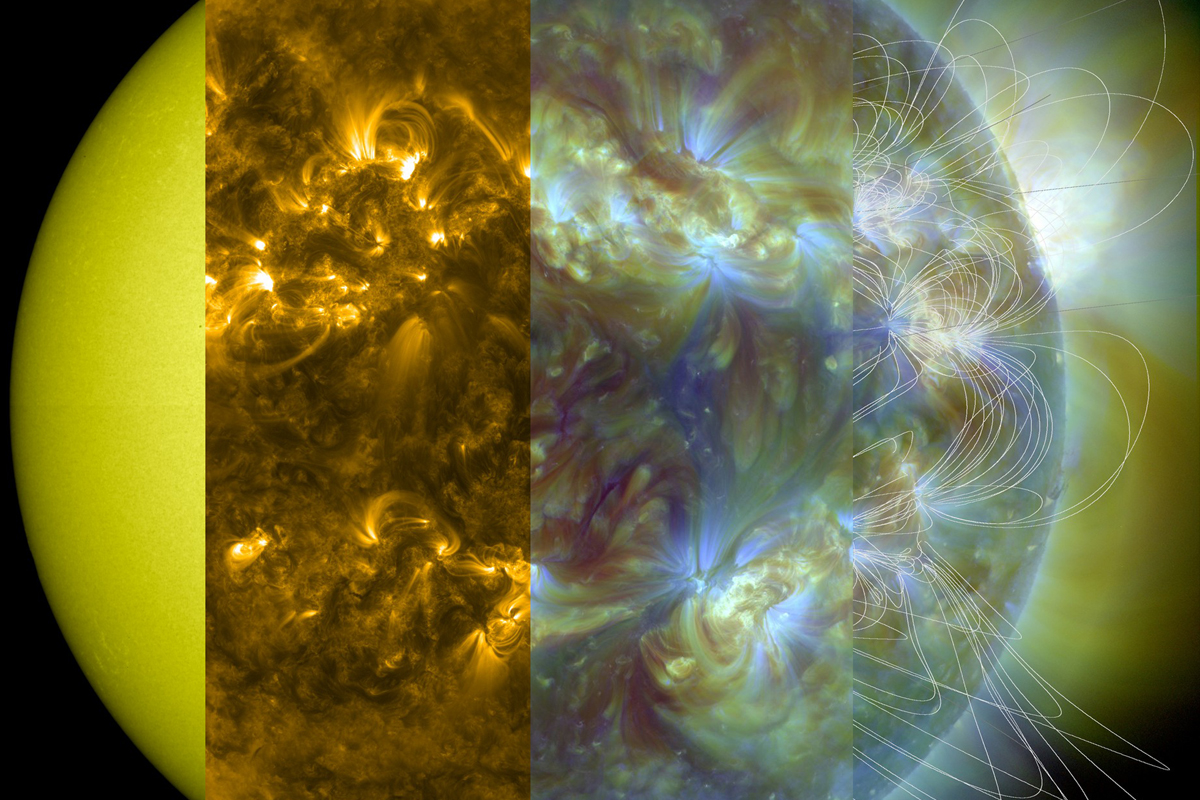
Data-driven solar activity for public events. Visitors use heliotime.org and helioviewer.org to explore the sun. They can print their favourite picture to take home. A great communication tool between visitors and scientists. We offered it twice at the Science Museum London.
Solar Flare Watch
Make your own gadget that lights up when the sun is active, e.g during a solar flare. Use near-realtime data from the GOES satellite and an Arduino. This is a collaborative work in progress. The code is available on github.
Science on a Table
We observe the Sun, our star, from different places and in many wavelengths. This exhibit shows different facettes of solar observation. It is designed as a communication tool between visitors and scientists. It’s one of our first exhibit – the one we brought to Brussels:-)

Hintergrundinfos
Wie wird das Weltraumwetter morgen? Sonnenaktivität und ihre Auswirkungen, Dr. Marina Battaglia, FHNW. Hintergrundinformationen für Lehrer, Dozentinnen, Medien, Museen, Amateurastronominnen und alle Interessierten. Download
Contact: hanna.sathiapal (at) raumschiff.org